Addressing Critical Knowledge Gaps in Newborn Health

Newborn Numbers

In many communities around the world, children are not named until they survive their first month of life – the neonatal, or newborn, period. The first 28 days of a baby’s life should be a time of joy, yet that month, especially birth and the days thereafter, carries the highest risk of death for both mothers and their newborns. Globally, 3 million newborns die each year, and 2.6 million babies are stillborn. Four out of five newborn deaths result from three preventable and treatable conditions: preterm birth; infections; and complications during childbirth or birth asphyxia.

The pace of progress toward Millennium Development Goal (MDG) 4 for child survival is accelerating as the 2015 target draws nearer. Across the world, more newborns are alive and healthy today than even five years ago, but a lack of political attention and resources continue to contribute to the slow progress in saving newborn lives. While newborn deaths have decreased from 4.4 million in 1990 to 2.9 million in 2011, this decline is a third slower than for under-five deaths after the first month of life. As a result, the proportion of under-five deaths happening in the first four weeks of life has increased – today newborns account for 43% of deaths among all children under-five – up from 36% in 1990.

Since 2000, major advances in the evidence base for newborn survival have enabled countries to pave the way for impact at large scale, showing that rapid change is possible. Thanks to joint efforts by multiple national and global stakeholders, we have begun to bend the curve for newborn survival.

Trends showing progress, lessons learned, and success stories are proof that efforts to save newborn lives have been effective. Using data and evidence to drive action is critical to ensure this momentum continues. 

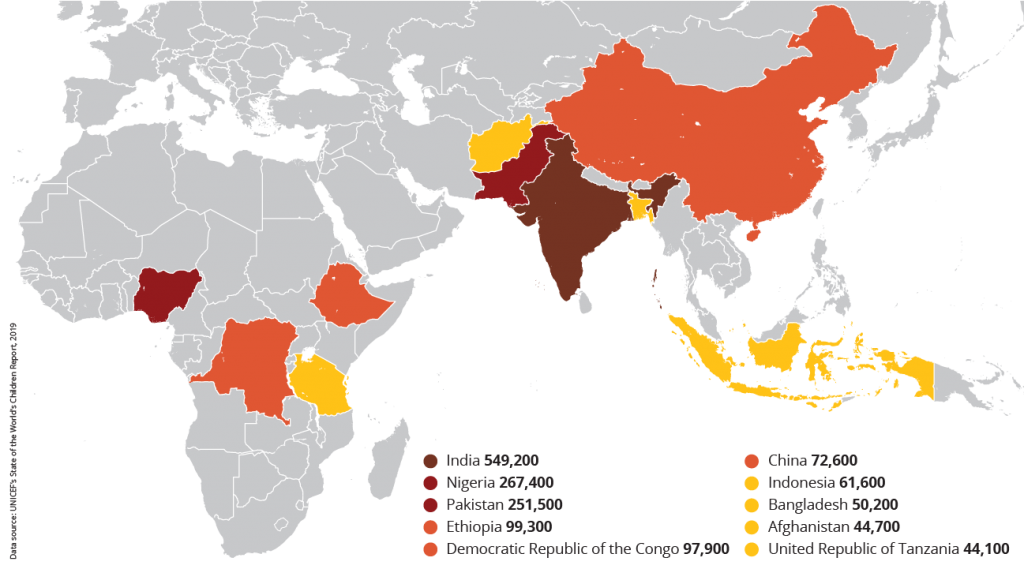
Over half of under-5 deaths are newborns in all regions except sub-Saharan Africa and Oceania. More than three-quarters of the world's newborn deaths occur in South Asia and sub-Saharan Africa.1 With 2,955,000 annual newborn deaths in 2011, ten countries alone make up for 65% of the total annual number of neonatal deaths. These same 10 countries also account for nearly 60% of maternal deaths worldwide.2 In Sub-Saharan Africa alone, an estimated 1,122,000 babies die before they reach one month of age.Between 2000 and 2010, neonatal mortality reduced 17% and the rate of progress is slower than reductions in maternal and child survival past the first month of life.3

Three main causes of death — severe infections, complications of prematurity, and intrapartum-related deaths ("birth asphyxia") — account for more than 80% of newborn deaths globally.4 Of these, 3/4 occur during the first week of life, and up to 50% in the first 24 hours. Over two-thirds of newborn deaths could be prevented annually through the high coverage of low-cost, low-tech maternal and newborn health interventions.

Learn about the 3 main causes of newborn death:

The latest estimates of global newborn deaths each year are4:

  • Complications of prematurity: 1,078,000
  • Intrapartum-related deaths ("birth asphyxia"): 717,000
  • Severe neonatal infections (pneumonia, sepsis or meningitis) : 717,000

Some countries have achieved remarkable progress in reducing neonatal mortality. Five countries have more than halved their neonatal mortality rates between 2000 and 2010 (Turkey, Oman, Greece, Belarus and Estonia).3 

Countries that have achieved increases in contraceptive use and concurrent reductions in fertility have made more progress for newborn survival. Sub-Saharan Africa was the region with the least progress, which has had, on average, no significant change in neonatal mortality rate during the last decade. Though starting at lower preterm birth rates, some high-income countries, such as Canada, Switzerland and the United States have also made little progress since 2000, perhaps due to increasing preterm birth prevalence. 

Source: Lawn JE,et al. A decade of change for newborn survival, policy and programmes (2000–2010). Health Policy and Planning. 27(Suppl. 3). 2012.

Coverage along the continuum of care

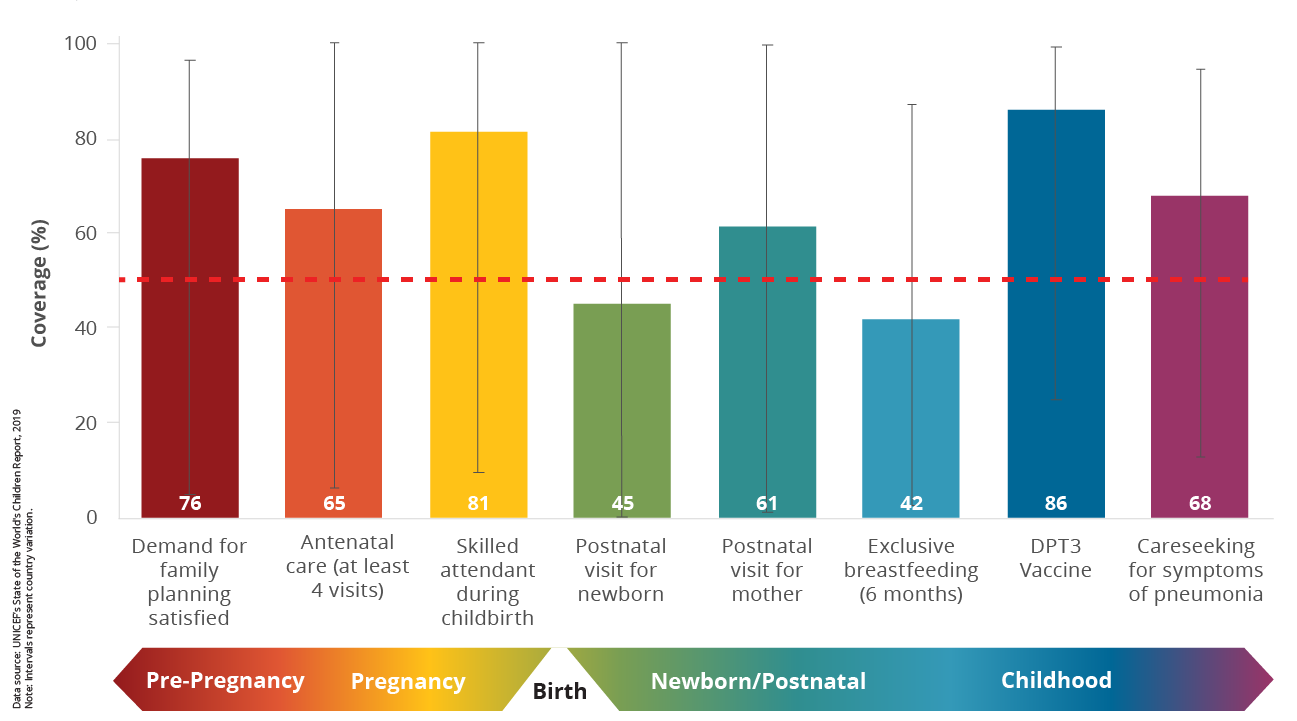
Evidence-based strategies to save the lives of women and babies include a menu of interventions, which are usually provided through integrated service delivery packages at different levels along the continuum of care.5 National coverage data is available for some service delivery packages (e.g. antenatal care, skilled attendance) and for a few specific interventions that have been a focus for a longer time, such as tetanus toxoid immunization. Other high impact neonatal interventions with recent attention, such as Kangaroo Mother Care and neonatal resuscitation, have no national data available. More information about newborn health indicators and available data coming to HNN soon.

Countdown to 2015. Accountability for Maternal, Newborn and Child Survival: An update on progress in priority countries. March 2012. Note: median for 75 Countdown priority countries with available data; bars refer to ranges between countries.
 

The following resources are recommended sources for global and country data. Take a look at the trends and progress towards improving newborn health around the world. 

Each year, The State of the World's Children, UNICEF's flagship publication, closely examines a key issue affecting children. The report includes supporting data and statistics that can be downloaded in MS Excel format and is available in French and Spanish language versions.

Childinfo contains UNICEF’s statistical information, including data used in UNICEF’s publications, The State of the World’s Children and Progress for Children. In addition, Childinfo holds technical resources for conducting UNICEF-supported Multiple Indicator Cluster Surveys (MICS), a major source of global development data. 

Multiple Indicator Cluster Survey: UNICEF assists countries in collecting and analyzing data in order to fill data gaps for monitoring the situation of children and women through its international household survey initiative the Multiple Indicator Cluster Surveys (MICS).

WHO Neonatal Mortality Statistics. Raw data inputs for country neonatal mortality estimates can be downloaded here, including latest estimates and methodology for neonatal mortality.

World Health Statistics is the WHO's annual report that presents the most recent health statistics for 193 member states. All reports are available for download in Adobe PDF and MS Excel and include country-level data on mortality rates, cause of death, human resources and coverage indicators. In addition, the Global Health Observatory is WHO's portal providing access to data and analyses for monitoring the global health situation.

Child Mortality Estimates (CME Info) is a database containing the latest child mortality estimates based on the research of the UN Inter-agency Group for Child Mortality Estimation.


The Countdown to 2015 Initiative tracks coverage levels for health interventions proven to reduce maternal, newborn and child mortality. Download the latest report and access country-specific profiles for 75 countries.


The DHS program, funded by USAID, provides technical assistance to countries to conduct surveys on population, health, HIV and nutrition, advancing global understanding of health and population trends in developing countries. Reports, survey questionnaires, and related materials are available for downloading. The DHS website also includes STATcompiler, which provides quick facts and country comparisons, allowing users to build customized tables from hundreds of DHS surveys and indicators. 

The Institute for Health Metrics and Evaluation (IHME) is an academic institution in The University of Washington, Seattle, USA. IHME works to advance modelling methods for global health issues including mortality, health financing, among others. It also coordinates work for the Global Burden of Disease studies.


The Guttmacher International Data Center allows users to create tables and maps with the most current data available from 75 countries and 22 world regions. The Data Center is an easy to use tool for finding information on abortion, pregnancy, services and financing, adolescents, and contraception.


Key newborn health publications:

The supplement, "A decade of change for newborn survival (2000-2010): a multi country analysis of progress towards scale", published in Health Policy and Planning, presents a comprehensive multi-country analysis of the changes in newborn care and survival from 2000-2010 and 5 detailed country case studies in order to better understand the process of taking solutions to scale and how to accelerate progress for reduction of mortality and morbidity. It was coordinated by Save the Children’s Saving Newborn Live program, and funded by the Bill & Melinda Gates Foundation in collaboration with over 150 contributors (mainly in-country partners). 

The first-ever national, regional and global estimates preterm birth  were published in Born Too Soon: The Global Action Report on Preterm Birth in 2012.

  •  

The first ever global and national estimates of stillbirths were presented in The Lancet Series on Stillbirth, which also provided the most comprehensive assessment to date of global numbers and causes of stillbirths, perceptions and beliefs around the world, and the solutions to prevent stillbirths—well-known interventions as well as innovations.


The December 2010 issue of Seminars in Perinatology higlights Global Perinatal Health. The papers provide insight on accelerating progress through innovations, interactions, and interconnections. Read the article that reviews progress for newborn health globally, with a focus on the countries in which most deaths occur.  


References:

  1. UNICEF, WHO, The World Bank, UNFPA. 2012. Levels and trends in child mortality, report 2012. New York: UNICEF.
  2. WHO, UNICEF, UNFPA, The World Bank. 2012. Trends in maternal mortality 1990-2010. Geneva: World Health Organization.
  3. Lawn JE, Kinney MV, Black RE et al. Newborn survival: a multi-country analysis of a decade of change. Health Policy and Planning, 2012; 27(Suppl. 3):iii6–iii28.
  4. Liu L, Johnson H, Cousens S et al. 2012. Global, regional and national causes of child mortality: an updated systematic analysis. Lancet. 379(9832):2151-61.
    Kerber KJ, de Graft-Johnson JE, Bhutta ZA et al. 2007. Continuum of care for maternal, newborn, and child health: from slogan to service delivery. The Lancet 370: 1358–69.